Kerala’s Medical Manuscripts Enter the Digital Age
-
by
AHT Desk
Severity: Warning
Message: Trying to access array offset on null
Filename: controllers/Ayurveda.php
Line Number: 169
Backtrace:
File: /var/www/vhosts/ayurvedamagazine.org/httpdocs/application/controllers/Ayurveda.php
Line: 169
Function: _error_handler
File: /var/www/vhosts/ayurvedamagazine.org/httpdocs/index.php
Line: 295
Function: require_once
Severity: Warning
Message: Trying to access array offset on null
Filename: controllers/Ayurveda.php
Line Number: 169
Backtrace:
File: /var/www/vhosts/ayurvedamagazine.org/httpdocs/application/controllers/Ayurveda.php
Line: 169
Function: _error_handler
File: /var/www/vhosts/ayurvedamagazine.org/httpdocs/index.php
Line: 295
Function: require_once
Severity: Warning
Message: Trying to access array offset on null
Filename: controllers/Ayurveda.php
Line Number: 170
Backtrace:
File: /var/www/vhosts/ayurvedamagazine.org/httpdocs/application/controllers/Ayurveda.php
Line: 170
Function: _error_handler
File: /var/www/vhosts/ayurvedamagazine.org/httpdocs/index.php
Line: 295
Function: require_once
Severity: Warning
Message: Trying to access array offset on null
Filename: controllers/Ayurveda.php
Line Number: 170
Backtrace:
File: /var/www/vhosts/ayurvedamagazine.org/httpdocs/application/controllers/Ayurveda.php
Line: 170
Function: _error_handler
File: /var/www/vhosts/ayurvedamagazine.org/httpdocs/index.php
Line: 295
Function: require_once








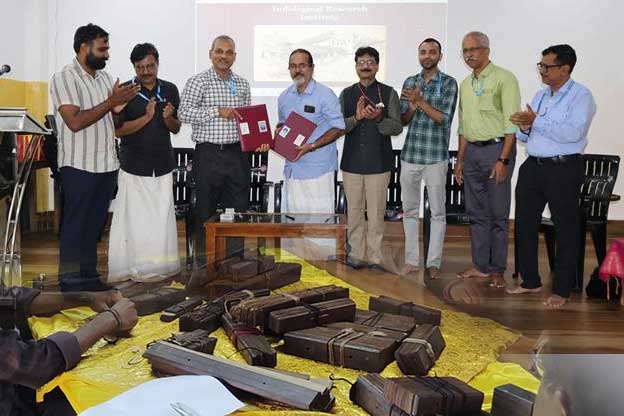
Hundreds of rare medical manuscripts preserved for generations at the Sevadhi Museum and Indological Research Institute (SEMIRI), Kumaranalloor, Kottayam, Kerala, are set to enter the digital domain under a new collaboration aimed at protecting Kerala’s traditional medical heritage from the risks of age and physical deterioration.
The National Institute of Indian Medical Heritage (NIIMH), Hyderabad, under the Central Council for Research in Ayurvedic Sciences (CCRAS), Ministry of Ayush, has signed an MoU with SEMIRI for the systematic digitisation and cataloguing of its medical manuscript collection on August 14.
The initiative is significant for Kerala’s history of Ayurveda and scholarship. SEMIRI, managed by the Kumaranalloor Ooranma Devaswom, holds more than 30,000 manuscripts, including temple records. Among them are rare texts dealing with Ayurveda and allied traditions, offering primary material on therapeutic practices, materia medica, diagnosis and the evolution of medical thought.
The project goes beyond simply photographing old manuscripts. CCRAS-NIIMH will prepare a detailed descriptive catalogue recording, wherever available, information such as title, author, subject, script, language, material, dimensions, folio details, condition and provenance. The records will follow the format of the Ayush Manuscripts Advanced Repository.
For researchers, that catalogue could prove as important as the digital images themselves. It will make scattered and often difficult-to-identify sources easier to locate, compare, and study, opening the way for research in Ayurveda, manuscriptology, the history of medicine, and Indian Knowledge Systems.
The digitisation will also reduce repeated handling of fragile originals. High-quality digital surrogates can preserve the intellectual content of manuscripts while allowing researchers to consult them without placing additional physical stress on ageing material.
The project comes against the backdrop of the Gyan Bharatam Mission and wider government efforts to document and digitise India’s manuscript heritage. Medical manuscripts occupy a distinctive place in that effort because they preserve not only texts, but records of how medical knowledge was transmitted, interpreted and practised across generations.
Prof. Vaidya Rabinarayan Acharya, Director General of CCRAS, described the preservation of medical manuscripts as more than an archival exercise, stressing their importance for safeguarding India’s intellectual heritage and enabling evidence-based research.
SEMIRI president Dr. C.S. Unni highlighted the collaboration as an opportunity to bring the manuscript heritage of Kumaranalloor and the wider Kottayam region into greater scholarly visibility. Dr. Goli Penchala Prasad, Head of CCRAS-NIIMH, highlighted the ongoing challenges in manuscriptology and the need for systematic approaches to documenting Ayurveda’s textual heritage.
The work has already moved from agreement to implementation. A specialist CCRAS-NIIMH team, working under the institute’s Collection, Digitization and Cataloguing of AYUSH Manuscripts and Rare Books project, has begun on-site digitisation.
The eventual resource could serve as more than a digital archive. Properly catalogued and made accessible, these manuscripts may provide the raw material for critical editions, textual comparisons and new studies of Kerala’s medical traditions.
For Kerala, the significance lies in rescuing a largely inaccessible body of knowledge from remaining confined to fragile physical collections. For scholars, it offers the prospect of discovering primary sources that have survived largely outside the mainstream of modern academic research.
The MoU thus represents a shift in how Kerala’s medical past is preserved: not simply by keeping manuscripts safe on shelves, but by documenting them systematically and creating a durable digital record through which future scholarship can engage with them.
Reference: PIB
editorial coordinator