
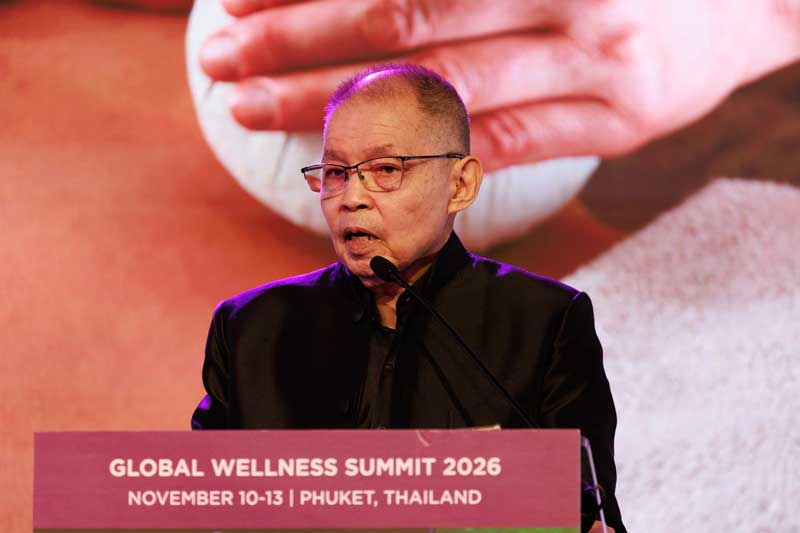
At the Global Wellness Summit 2026 in Phuket, Chiva-Som Chairman and CEO Krip Rojanastien called for a more human-centred approach to wellness, urging the industry to balance scientific innovation with traditional wisdom, individual understanding and preventive healthcare.
As wellness becomes increasingly driven by data, diagnostics and technology, Krip Rojanastien believes the industry risks overlooking its most important element: the individual.
Delivering a keynote at the Global Wellness Summit 2026 in Phuket, Thailand, Krip recently challenged the sector to look beyond precision and measurement to a more personal understanding of health. His central argument was simple: knowing more about the human body does not necessarily mean knowing how to make people healthier.
“The future of wellness does not depend on how much more we can measure. It depends on how much better we become at helping people understand themselves,” he said.
The Chairman and CEO of Chiva-Som International Health Resorts argued that prevention must become central to healthcare, particularly as non-communicable diseases place growing pressure on health systems. But effective prevention, he stressed, cannot rely on technology alone. Lifestyle, relationships, emotional health, environment and individual behaviour must all inform the approach.
Drawing on Thai Traditional Medicine, Krip advocated bringing ancient healing philosophies into meaningful conversation with modern science. The traditional understanding of balance through the four elements – Earth, Water, Wind and Fire – offers a perspective that complements contemporary medicine. The Buddhist principle of the Middle Way, meanwhile, reinforces the importance of moderation: knowing when to push, when to pause and when to recover.
He also questioned the industry’s growing reliance on standardised wellness protocols. Similar health measurements, he noted, can mask vastly different individual needs. Personalisation must therefore extend beyond biomarkers to empathy, observation and informed human judgement.
“Consistency is essential. Interchangeability is not,” he remarked, warning against allowing systems to replace the practitioner’s ability to listen.
Looking ahead, Krip called for wellness education to begin early, stronger community connections and greater environmental responsibility. Ultimately, the objective should not simply be to extend life, but to improve its quality.
His message was a timely reminder that wellness is not a technology to be mastered, but a lifelong practice of understanding, balance and conscious living.

Global Ayurveda Summit & Kerala Health Tourism Summit in Kochi from Nov 20; focus on global markets and modern healthcare
Kochi will become a meeting point for traditional healing and contemporary healthcare innovation as the 8th CII (Confederation…