
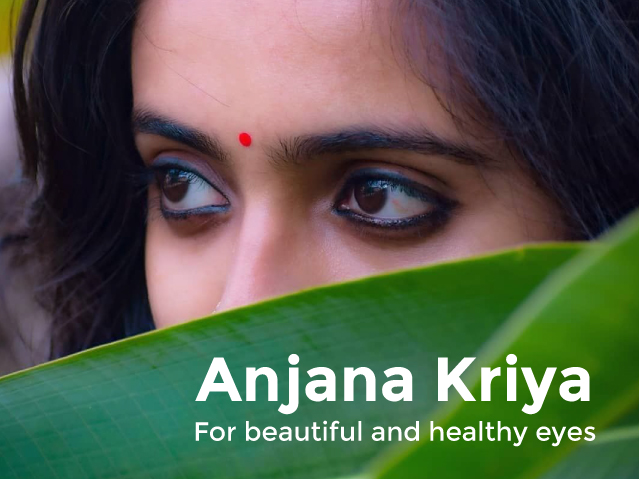
“Sarva
indriyaanaam nayanam pradhaanam”(Eyes are the most important among
the sense organs)
Ther
is no better way to describe the importance that Ayurveda attaches to the eyes.
Eyes tell the story about a person. When two eyes meet, a silent communication
happens. For some, a simple eye contact is sufficient to delve deep into a
person. Eyes radiate energy in a healthy person. They also give out the first
signs of a person’s failing health. For female of the species, eyes hold in
them something magical to charm to the beholder.
In
Ayurveda, eyes are referred to as ‘Nayana’, ‘Chakshu’, and ‘Netra’.
Eyes have two functions: vision and perception of knowledge. Thus, eyes are
known as ‘Chakshurindriya’. The eyes, therefore, need to be kept at
optimal health. And, as eyes mirror one’s personality, it should also be kept
beautiful, clean and communicative. In Ayurveda, all these three objectives are
sought to be achieved through the application of collyrium or ‘Anjana’, a thick
eyeliner made with herbs.
The eyes are susceptible to infections since they are often
exposed to smoke and dust. Sudden changes in weather too can have an adverse
effect on the eyes. To reduce irritation caused by environmental factors, drops
or salves are often applied in the eye; they act as cleansing agents.
Ayurveda employs the use of drops and salves in the treatment of
eye diseases like itching, burning sensation, pain, redness, etc.
Regular use of Anjana (collyrium), a medicinal eye liner, would
also make one’s vision clearer. It will add to the sparkle of the eyes, and
enhance their ability to withstand bright light.
Anjana is basically of three kinds – scarifying (lekhana),
healing (ropana) and eye-invigorating (drishti prasadana).
The lekhana anjana is prepared from drugs having astringent,
sour, salt or pungent taste, and hot potency. Ropana anjana, which is
made from bitter drugs, has a cooling effect and lends strength and colour to
the eye. Drishti prasadana anjana is made from sweet drugs that have
cold potency. This tones up and improves vision.
The excess of doshas in the eye, eyelids, eyeballs,
capillaries and the nose gristle is drained through the mouth, nostrils and
corners of the eye by applying the scarifying salve. Application of prasadana
salve to eyes that have become fatigued by application of strong collyriums is
known as counter- collyrium (pratyanjana).
Anjana vidhi (method of applying
collyrium)
Ashtangahridaya says: “Application
of collyrium is suitable for a person who has his/her body purified (through
emesis, purgation, etc.), in whom doshas are localised in the eyes; when
there is slight oedema, severe itching and sliminess; when eye excretions are
thick; and in those troubled by Pitha, Kapha, Rakta and especially Vata”
– (AH Soo. 23.8-9).
A metallic eye-liner, ten angula (finger units) in length,
which is thin in the middle and tips resembling a flower bud is the best for
applying anjana. An eyeliner made of copper is good for lekhana;
an iron eyeliner for ropana; and one of gold or silver for prasadana.
Kinds of Anjana
Eye salve can be in the form of pill or dragee (pinda), gel
or confection (rasakriya) or powder (choorna), and are used in
conditions of profound, moderate and mild increase of doshas respectively.
The amount of salve to be applied, when it is in the form of a
hard pill and prepared from strong drugs, is one harenu (black cardamom).
And if prepared with mild drugs, it should be two harenu.
When in the form of a gel, the amount should be that of vidanga
(Embelia Ribes). If it is in powder form and made from mild drugs, you should
use more of the anjana than when it is made from strong drugs.
Persons unfit for eye salve (anjana anarhah)
Eye salve should not be applied in situations such as when you are
in a state of fear, anger or grief or you have been administered emesis or
purgation and when you are thirsty or hungry. It should be avoided also when you
are down with fever or headache, when the eyes are tired and if you have not
had enough sleep.
It should be avoided soon after washing your hair, Smoking or
drinking wine or if you are fatigued after too much exposure to fire or the
sun. The salve should not be too strong or mild, and the quantity used not very
little or too much. It should neither be too cold or hot, and the consistency
not very thin or thick.
After applying the salve, eyeballs should be moved up and rotated
slowly; eyelids should also be washed gently with water suitable to the
disease, the doshas and the season.
If not washed away, the salve remaining in the lids will excite
the doshas, causing diseases. In case of itching or weakness in the eye,
one should apply a strong salve or inhale strong medicated smoke.
When the eyes are fatigued by the use of strong eye salve, apply pratyanjana
(counter eye slave) which is in powder form and cold in effect.
How to apply
Keep the eyelids wide open with the fingers of the left hand and apply anjana
with the right hand. It should be applied from the sides