
Within
its theoretical universe, Ayurveda is a hold-all term that expounds a
profound philosophy about human existence and sustenance. But it is a universe
that also holds within it an amazing diversity, determined by primarily by the
specific geographies, flora, weather systems and cultural practices of the places
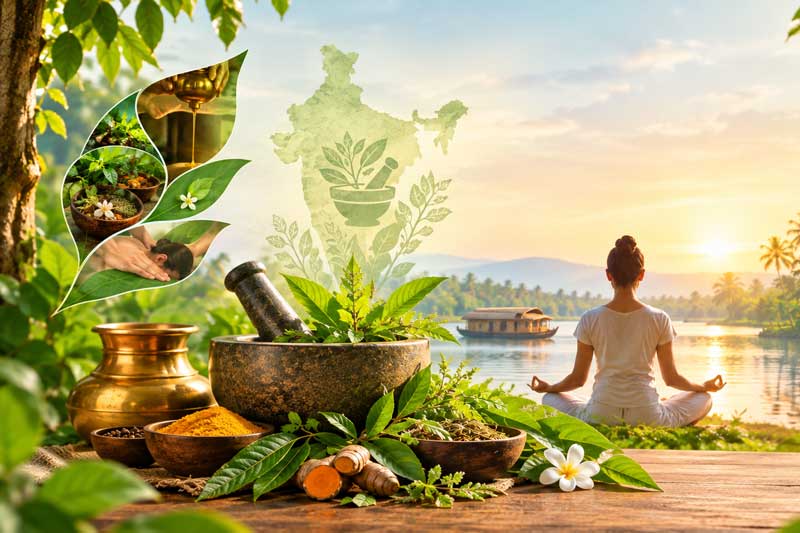
where it is practiced. Thus, Kerala’s Ayurvedic legacy is unique to the
land where life, both human and floral, are determined by the tropical climate.
Historical narratives suggest that an organised
cosmopolitan system of institutional medical care may have evolved in India
before any other part of the world. The description of Fa Hien, sometime during
the first decade of the 5th century AD, and Charaka’s description of
how a clinic should be equipped give an insight into the codified evolution of Ayurveda
as a distinct discipline, probably at the time of Buddha.
The term Ayurveda means, literally, the
knowledge or science (Veda) for longevity (Ayus). It is called Ayurveda
because it tells us the about Vedayuti– which substances qualities and
actions are life-enhancing and which are not.
It is a system of general medical practice which
encompasses both preventive and prescriptive aspects. It consists of a great
deal of excellent practical advice for the man on the street on almost every
imaginable aspect of life, including cleaning the teeth, diet, exercise,
regimen, morality and so on.
Ayurveda also includes more specified medical teachings on
all aspects of diagnosis and therapy for the benefit of the professional
physician. One of the most important clusters of ideas in the Ayurvedic
tradition is that which relates to the humours (dosha) body tissues (dhatu)
and waste products (mala). The doctrine of three humours (thridhosha
vidya) expounds that three semi-fluid substances are present in the body
and regulate its condition under different circumstances.
The humours are Wind (Vata), Bile (Pitta)
and Phlegm (Kapha). These humours interact with
plasma, blood, muscle, fat, bone,
bone marrow and reproductive fluid present in the human body. In Ayurveda,
they are called Sapta Dhatus – Rasa, Rakta, Mamsa, Medha,
Asthi, Majja and Shukla respectively. This Tridosha doctrine is somewhat similar
to the ancient Greek humoral system of Hippocrates and Galen.
Ayurveda uses mainly animal and vegetable medicines
and it teaches a broad range of therapies including diet, enemas, massage,
bloodletting, leeching, ointments, douches, sweating and surgery. From the end
of the first millennium AD, metallic compounds came into medical use, but these
remained on the periphery of the Ayurvedic pharmacopoeia. In orthodox
medical practice, opium too was induced as an effective cure for diarrhoea and
as an ingredient in aphrodisiac philtres.
Throughout India or all over the world, Ayurveda
shares similar theoretical framework. However, there are a lot of regional
variants in its practical approach or treatment procedures. The Kerala stream,
known as the Keraleeya Chikilsa Kramam, is shown to be very effective in
treating neuro and arthritic diseases.
In practice, Kerala Physicians give special
emphasis to the five procedures (Panchakarma: Vamanam, Virechanam,
Rekthamokham, Nasyam and Vasthi) Sirodhara, Pizhichil, Navarakizhi,
Thalapothichil, Panchakizhi and Podikizhi are some of the procedures that
they follow. The preparatory procedures for Panchakarma, are known as Poorva
Kriya. Swedam and Snehapanam are some of the preparatory
procedures.
Physicians testify that these preparatory
procedures themselves become very effective in treatment of certain diseases.
No wonder they are inclined to employ these preparatory procedures as an
independent treatment mechanism.
The geographical peculiarities of the land, physical
constitution of the people, and the availability of herbs are important factors
that determine the unique approach to healing and therapeutic remedies in
Kerala. The Kerala tradition is largely influenced by Vagbhata’s Ashtangahrdayam
as compared to other classical texts.
Traditional physicians of Kerala affirm an
uninterrupted history of practising the classical Panchakarma therapies
in all their avowed purity and fidelity, with the enchanting flourish of the
innovative preparatory therapies and enhanced by a wide variety of exclusive
herbs-based formulations overshadowing the use of metal and mineral-based
drugs.
Certain socio-historical undercurrents too have
contributed to the development of typical treatment procedures and unique
approaches of Ayurveda in Kerala. There were two main Ayurvedic
streams—the Brahmin and the Non-Brahmin. Kerala Ayurveda’s origins lay
in the non-Brahmin tradition, which took shape even before the entry of
classical Ayurveda in the early centuries of the Christian era. These
two streams subsequently blended so well that it gave a unique strength to the
healthcare tradition of Kerala.
A few select Brahmin households, named generally as
Ashtavaidyas, were entrusted with the responsibility of maintaining the Ayurvedic
tradition by practising it as a healthcare service as well as by teaching
its principles in the unique gurukula tradition. The traditional
practitioners of Ayurveda considered Ashtangahridaya as a primary text.
Several commentaries and interpretations were written by experts here.
More importantly, new texts were written in Kerala,
both in Malayalam and Sanskrit. Sahasrayogam, Chikilsamanjari, Vaidyamanorama
are just a few examples. These and similar other Kerala texts still remain the
main sources of very useful information on formulation, medicinal plants and
therapies. Kerala physicians continued to practice and enrich the Panchakarma
therapy and made a lot of innovations in that area. Even when they became
defunct in the rest of the country due to socio-political reasons, Kerala
retained this therapeutic wealth in all its pristine glory.
A lot of academic innovations were incorporated and
texts like Vasthipradeepam were written here on its practical aspects. More
significantly, the famous Kerala special therapies were refined by the
practitioners here. They are essentially preparatory in nature. Dhara
mukkipizhichil, Navarakizhi, etc. are typical examples. As the practice of Ayurveda
expanded in popular acceptance in the recent past, these treatment modalities
have also become more prevalent.
There are several unique herbal formulations
described in Kerala texts. Many of them have now received national acclaim and
they are included in the Ayurvedic Formulary of India. One important aspect of
Kerala formulations is that the stress is more on herbal components rather than
on metals or minerals. There is also the history of Ayurvedic physicians
developing some areas of specialisations like paediatrics, ophthalmology, kalari
therapy, etc.
In sum, it is a rich
repertoire of theory and practice that the Kerala Ayurveda offers to the
world.