
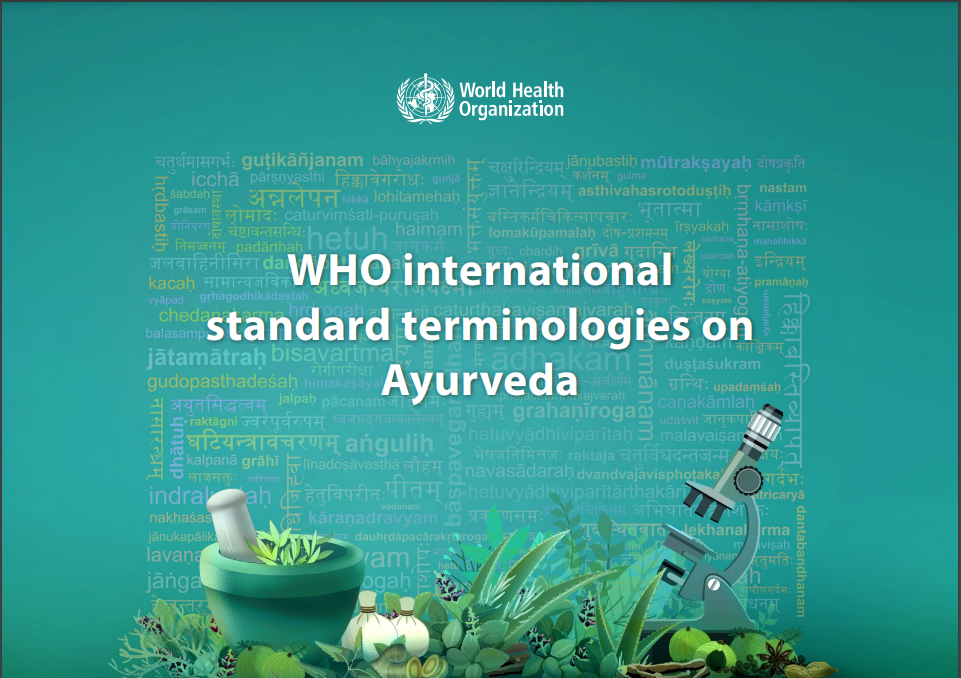
The WHO International Standard Terminologies on Ayurveda document
offers standardized definitions that can greatly benefit stakeholders
in the field of Ayurveda. These definitions support various aspects
such as education, practice, regulation, research, drug development,
and integration, ultimately contributing to the global advancement of
evidence-based and safe Ayurveda.
This comprehensive
resource provides standardized definitions for more than 3600
Ayurvedic terms, covering essential concepts and practices within
Ayurveda. Its impact extends to Ayurveda stakeholders worldwide.
Key Highlights:
1. Concise
definitions for fundamental Ayurvedic concepts are provided.
2. Core treatment
modalities, including panchakarma (five cleansing therapies) and
rasayana (rejuvenation therapy), are outlined.
3. Major diagnostic
frameworks, such as trividha pariksha (three-component examination)
and dashavidha pariksha (tenfold examination), are covered.
4. Clinical
conditions and disease classification systems are defined based on
Ayurvedic principles.
5. Key
pharmacognostic concepts and Ayurvedic approaches to drug preparation
are elucidated.
6. Fundamental
principles of Ayurvedic pathology, such as samprapti (evolution of
disease) and rogapariksha (disease assessment), are explained.
7. Ayurvedic
anatomical terminology for the entire body and specific structures is
standardized.
8. A glossary of
Sanskrit words and terms with English definitions is provided.