Website under modification!
Author: admin
-
WHO urged to revisit drinking water standards as nitrate health concerns mount
The safety of drinking water is facing renewed scrutiny, with 85 international health and environmental organisations urging the World Health Organization (WHO) to reconsider its decades-old nitrate limits amid emerging concerns over long-term health risks.
According to an AFP report published by ETHealthworld on November 3, the coalition, which includes Greenpeace International and the World Organization of Family Doctors (WONCA), has called on WHO to prioritise nitrate in its upcoming review of global drinking water quality guidelines.
The concern centres on the existing WHO limit of 50 milligrams of nitrate per litre, established in 1958 primarily to prevent methemoglobinemia, commonly known as ‘blue-baby syndrome’. However, campaigners argue that this benchmark no longer adequately reflects contemporary scientific evidence.
Recent epidemiological studies have linked prolonged exposure to even relatively low nitrate concentrations with increased risks of colorectal cancer, premature births and other adverse pregnancy outcomes. Children and pregnant women are considered particularly vulnerable.
Nitrate contamination is closely associated with intensive agriculture, including synthetic fertiliser use and livestock farming, raising concerns about pollution of groundwater and surface water. The coalition warns that hundreds of millions of people worldwide could be exposed to elevated nitrate levels.
Adding weight to the demand, a Danish government-commissioned expert panel recommended lowering the permissible limit to 6 milligrams per litre. Denmark has committed to moving towards this stricter standard.
The appeal highlights a growing public health challenge: drinking water regulations must evolve alongside scientific understanding. For WHO, the proposed review could become an important step towards strengthening global water safety and preventing avoidable disease.
WHO’s Guidelines for Drinking-water Quality retain a nitrate guideline value of 50 mg/L, intended to protect against methaemoglobinaemia (blue-baby syndrome), particularly in bottle-fed infants. Its 2026 guidance also explains that the guidelines provide the scientific basis for countries to develop their own drinking-water standards.
References: World Health Organisation, AFP, ETHealthworld
-
Youth Must Become the Face of India’s Fight Against Tobacco: Prataprao Jadhav
India’s fight against tobacco can be won if young people take the lead to challenge social acceptance of tobacco consumption, besides government warnings and awareness advertisements. They should turn the fight into a nationwide people’s movement, Union Minister of State for Health Prataprao Jadhav has said in New Delhi.
Launching the fourth edition of the 60-day Tobacco-Free Youth Campaign (TFYC 4.0) on October 28, at Dr Ram Manohar Lohia Hospital in New Delhi, Jadhav urged students and young citizens to become ambassadors of a tobacco-free India. He stressed that protecting the younger generation from nicotine addiction was essential to building a healthy and developed nation.
The campaign’s message is: prevention must begin before tobacco becomes a habit. With universities and colleges as the primary focus this year, the initiative seeks to transform educational campuses by offering healthy choices to discourage tobacco.
The challenge remains substantial. According to the Health Ministry, more than 5.8 lakh educational institutions and 73,000 villages were declared tobacco-free during the previous three editions. The latest drive will combine public awareness, stronger enforcement of tobacco control laws, community participation, digital outreach and cessation support.
Jadhav also drew attention to the dangers of tobacco smoke, which contains over 7,000 chemicals, including toxic and cancer-causing substances. Nicotine exposure during adolescence can adversely affect brain development, memory and learning, making early intervention particularly important.
However, the real test lies beyond official launches and pledges. Young people must challenge peer pressure, discourage tobacco use among friends and encourage existing users to seek help to quit. Schools, families and local communities must support this effort.
The message is clear: India’s youth should become the strongest advocates of a tobacco-free generation. It will require collective action, sustained commitment, and a change in social attitudes.
References: Press Trust of India
-
From Earthen Tanks to Plastics: Silent Environmental Shift, Implications
Water is the most universal daily exposure in human life. Every individual interacts with water multiple times a day. While significant attention is given to water purification and contamination control, an important aspect of water safety remains relatively underexplored: the materials used to store water.
Many in India are shifting from traditional water storage methods—such as earthen vessels and cement tanks—to extensive use of plastic overhead water tanks. Installed on rooftops, these tanks remain exposed to intense sunlight, fluctuating temperatures, wind, and rain for prolonged periods.
At the same time, the global medical community has observed a rise in metabolic disorders, hormonal imbalances, infertility issues, and certain cancers. While these conditions are multifactorial, growing evidence suggests that environmental exposures, including chronic low-dose chemical exposure, may play a contributory role.This raises an important question:
Could modern water storage practices represent an overlooked environmental exposure deserving scientific attention?Historical Perspective on Water Storage
Traditional Indian water storage systems used locally available materials such as earthen vessels (Matka, Ghata), stone-lined reservoirs, cement tanks, and copper and brass vessels.
Earthen vessels provided natural cooling through evaporation, while stone and cement structures offered durability and chemical stability. Importantly, these materials did not undergo polymer degradation under heat.
Ayurvedic texts emphasize appropriate storage vessels (Bhajaniya Patra) and water purity, considering the vessel, storage duration, and environmental exposure. Thus, traditional practices reflected an early understanding that the storage medium influences the quality of stored water.Modern Shift to Plastic Overhead Tanks
Plastic tanks are lightweight, cost-effective, corrosion-resistant, easy to install, and require minimal maintenance.
However, most are installed in direct sunlight on rooftops, particularly in tropical climates where surface temperatures can exceed 45°C in summer. Prolonged thermal and ultraviolet (UV) stress raises questions about long-term material stability and chemical safety.Such tanks are typically HDPE or similar polymers. While considered food-grade, they are not entirely inert. Heat, UV radiation, and aging can cause surface oxidation, microcracking, polymer breakdown, and release of additives and microplastic particles.
Research has demonstrated that elevated temperatures can increase the migration of certain compounds from plastic into stored liquids (Muncke, 2009; Groh et al., 2019).
Among substances of concern are bisphenols, phthalates, styrene derivatives, and microplastics, which belong to or relate to the broader concern of Endocrine Disrupting Chemicals (EDCs). Microplastics have been detected in drinking water, human blood, placental tissue, and lung tissue, suggesting that environmental micro-exposures are increasingly becoming part of human biological systems (Leslie et al., 2022; Ragusa et al., 2021).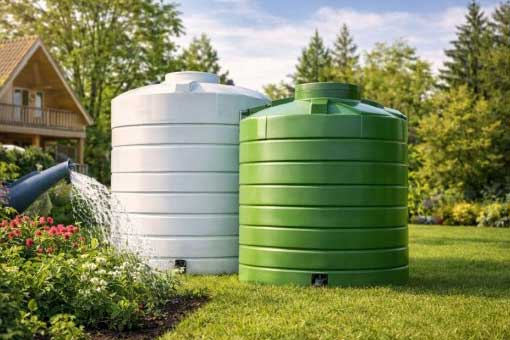
Possible Health Implications
Plastic water tanks are not the sole cause of modern diseases. However, the potential role of chronic environmental exposures cannot be ignored.
Endocrine-disrupting chemicals have been associated with hormonal disorders, including early puberty, thyroid dysfunction, fertility challenges, and PCOS (Vandenberg et al., 2012).
Some chemicals classified as obesogens influence fat metabolism and insulin sensitivity and have been associated with obesity, insulin resistance, type 2 diabetes, and metabolic syndrome (Heindel et al., 2015).
Endocrine-disrupting chemicals have also been studied in relation to hormone-sensitive cancers such as breast, prostate, and testicular cancer. These associations remain an active area of research (Diamanti-Kandarakis et al., 2009).Ayurvedic Perspective
Ayurveda places considerable emphasis on Jala Shuddhi (water purity) and proper storage methods. Classical texts describe copper vessels, seasonal adaptation in water handling, environmental exposure, and vessel hygiene.
From an Ayurvedic perspective, environmental contaminants may be interpreted as external toxic influences (Agantuja factors) capable of disturbing internal equilibrium. Chronic exposure to unsuitable substances may contribute to Agnimandya, Ama formation, and Kapha–Meda Dushti.
While ancient texts do not refer to plastics, their emphasis on vessel suitability and environmental purity remains relevant.Practical Preventive Considerations
Recognizing potential risks does not imply abandoning modern materials but thoughtful use and design.
Possible measures include:
▶ Use of certified food-grade, UV-stabilized plastic tanks
▶ Protective shading over rooftop tanks
▶ Periodic inspection and replacement of aging tanks
▶ Regular cleaning to prevent biofilm formation
▶ Considering RCC tanks, underground storage systems, and stainless steel tanks where appropriateScope for Future Research
The relationship between plastic water storage and long-term health outcomes remains underexplored, particularly in regions with extreme climatic conditions.
Research should examine microplastic levels in stored water, comparison of storage materials, temperature-related chemical migration, and long-term health outcomes in high-temperature environments.
Collaboration among public health experts, material scientists, environmental researchers, clinicians, and Ayurvedic scholars could provide meaningful insights.Conclusion
Modern water storage practices have improved accessibility and convenience. However, as infrastructure evolves, its health impact needs reassessment.
The widespread use of rooftop plastic tanks represents a silent but universal environmental exposure. While current evidence does not establish a direct link between plastic storage and disease patterns, emerging research on microplastics and endocrine-disrupting chemicals highlights the need for investigation.References
- Diamanti-Kandarakis, E., et al. (2009). Endocrine Reviews.
- Groh, K. J., et al. (2019). Science of the Total Environment.
- Heindel, J. J., et al. (2015). Nature Reviews Endocrinology.
- Leslie, H. A., et al. (2022). Environment International.
- Muncke, J. (2009). Environmental Science & Technology.
- Ragusa, A., et al. (2021). Environment International.
- Vandenberg, L. N., et al. (2012). Endocrine Reviews.